Showing posts with label Omnibuses Blog. Show all posts

24 August 2012

Quick vote

Just a quick pointer to todays Omnibuses blog:

Today, we’re giving readers the opportunity to vote for what they view as their favourite Plymouth Citybus livery of recent times. It’s a short, sharp poll and results will go live tomorrow at 0700 (itll be Saturday so certainly by 0800!). Read on for details

Omnibuses

12 July 2010

Omnibuses looks at Plymouth

Later this month, recently privatised Plymouth Citybus is making some cost-saving network changes aimed at protecting daytime frequencies. As part of this, a few evening services begin to become a thing of the past, though this is but round one of further changes likely to come in September…

More on Omnibuses


PTOTPA: Snap on Sunday
Uncle Terry! 151 Under threat
Omnibuses: What might have been
Plymouth Local History: Romans in Plymouth

18 October 2009

Plympton Coachlines


"John Preece doesn’t intend giving up his desire to operate Plymouth city services, not without a fight”


PlymTransit on Twitter
This is a Guess post by Omnibuses2.0:

At Omnibuses2.0 we aim to reflect in bite-sized pieces, the many facets of the UK bus industry. The first posts date from 2003 and since the summer of 2005, we’ve been examining the bigger picture almost daily...
This is a guest post by the Omnibuses Blog

John Preece doesn’t intend giving up his desire to operate Plymouth city services, not without a fight. Though it appears the council has rejected his bid to buy Plymouth Citybus, he threatens court action. Preece himself says he’s been waiting for Citybus for 21 years. It was in 1988, one year after his Plympton Coachlines bought Western National (with a little help from Badgerline) that Preece as MD began what was to be a doomed combative action, throwing at Citybus much that was second hand, plus a half-dozen or so brand new Leyland Lynxes. But that wasn’t the first time Plympton Coachlines had tried. No, the first time was back in regulated 1983…

Back then, Preece didn’t appear as Plympton Coachlines’ front man. Plympton Coachlines was one of a handful of operators who tried to exploit the Transport Act 1981 that made it easier for operators to gain stage carriage road service licences (as they were then called). Though the 1981 Act is famous for deregulating express coaches and for trial bus service areas, the forgotten provision was that it allowed start ups to challenge established operators, through the traffic courts. Stagecoach famously tried and only marginally succeeded. Plympton Coachlines completely failed.

Plympton Coachlines applied for two licences, one from Plymouth to its airport and the other between Plymouth & an area in outer Plymstock. Both offered something new. Opposed were Plymouth council and Western National, (partners in the then Plymouth Joint Services) and Devon council.

There were concerns, too, about abstraction. The only way, for example, that Plympton Coachlines might make either service pay was by abstracting along its route. Solicitors were successful in persuading the traffic commissioners that Plympton Coachlines’ lower fares and hourly frequency would force PJS to lower theirs. Since the city council expected PJS to break even, there would inevitably be compensatory cuts elsewhere, between £375,000 and £1mil worth per annum. The traffic commissioners were not prepared to see such damage inflicted upon Plymouth and refused Plympton Coachlines’ applications.

One of defendants’ main arguments was Plympton Coachlines’ zero experience in operating bus services. To think that in just four year’s time, Plympton Coachlines would have all the knowledge it would ever need, upon the take-over of Western National and the 1988 bus war that ensued.
HFX 424V (by TGPhotos) ©Terry Partridge. Plympton Coachlines HFX424V Ford R1114 Plaxton at Bretonside

26 February 2007

Sad but inevitable

The always interesting Omnibuses Blog comments on the impending sale of Plymouth Citycoach:

It’s sad but inevitable. The recent announcement that Plymouth CityBus is to sell its coaching arm comes as little surprise. Why? The coaching market is becoming increasingly difficult and differentiated. Margins rarely cover vehicle investment and core bus businesses are more profitable.

Article continues here. Its well worth a visit.

01 October 2006

Because I am an anorak

My posting a couple of days ago attracted another comment from Busing:

Should you be so hard on Plymouth? There may be issues but
generally speaking operators just get on with the job!

He makes a fair comment - I probably am being a bit harsh. Public transport in Plymouth is in reality no worse than most other cities in England. Its certainly not the operators fault that one of the best systems in the country just happens to be on their doorstep. It is also ironic that Plymouth is actually seeing a decent investment in new buses this year with the Park and Ride Enviros due in a couple of months which will be the envy of park and ride passengers across the country. This very weekend has seen the delivery of three new Enviro single deckers to Plymouth Citybus for the 34 service. Its not just new buses as First Devon and Cornwall are bringing secondhand Tridents into Plymouth from Bath - the first being reported as noted on delivery today. Three almost new Tridents are also coming up from Cornwall to enter service in Plymouth.

Of course both Busing and myself know a lot more about the bus scene across the country than most passengers. We both know that the issues which are leading to higher fares and cuts to bus services are national issues and Plymouth is indeed no worse than anywhere else. A quick search on Google News on 'bus route' will bring up news of passengers up in arms about cuts to their local services all across the country. Local passengers though dont know and dont care about what is happening anywhere else. They just want a regular bus service they can rely on that serves the areas where they live and work. When I defend the bus companies to my fellow passengers I can never win the argument. When the bus companies defend their own actions they too can never win the argument - certainly not in the local press where bus companies are always seen as the bad guys. And of course, as much as I try to be possitive about the local bus service - when I am getting told off at work for being late three times in one week - because the bus has not turned up - or has been fifteen minutes late - I can see their point.

I will still catch the bus and will still try to to be positive. I am after all - an anorak!

25 June 2006

Soapbox Sunday - The Stagecoach approaches?

"A soapbox is a raised, improvised platform on which one stands to make an impromptu speech, often about a political subject. Alternately, the word may be used to describe the box that soap comes in." Wikipedia

This year has seen an increase in bus companies changing hands with Stagecoach in particular being involved in a few deals to buy out a few smaller companies and two major companies. Go Ahead and Arriva have also made a few purchases over the past year, Arriva mostly buying in Europe. First have been a bit quiet on the bus front but have taken on a lot more rail work One or two overseas groups are also taking more of an interest in bus operation in this country at the moment with Transdev taking Bournemouth being the most interesting.

In most of these cases the takeovers were either open secrets - or at least strong rumours well before the events. With the growth of the email groups news gets out almost instantly these days and it can be quite hard for companies to keep things quiet as just one careless manager or staff member letting something out in a conversation can be all over the internet within a few hours!

This last week has seen a major announcement though that seems to have caught everyone by surprise. Stagecoach has just sold its London buses operations to an Australian Bank:

Stagecoach yesterday sold its London bus operations for £263.6m to Australian bank Macquarie, telling shareholders it could generate higher revenues away from the capital's tightly regulated
franchises. The bus, coach and rail group said funds from the deal could be better used developing services in deregulated markets in the north of the England.

Stagecoach will look for further organic growth and bolt-on acquisitions for its remaining British bus business, where it has expanded in Merseyside, Yorkshire, Lincolnshire and Tayside over the past year, chief executive Brian Souter said.

and of Macquarie...

Like the Australian football team, Macquarie is nothing if not tenacious. It looks possible it will lose out on its bid for AB Ports much as it lost out last year on a bid for the London Stock Exchange, but it has jumped up the international league with recent deals. Macquarie is one of the banks involved in Eurotunnel and own Bristol and Birmingham airports. The bank has 8,000 staff in 24 countries and runs the gas pipelines in Wales and the west of England. Macquarie can trace its roots to the defunct Hill Samuel City investment bank. It became Macquarie in 1985.

Above copyright www.Guardian.co.uk

So far so good, but what does this have to do with Plymouth? Well, in the short term maybe not a lot, but Stagecoach is knocking on the door of Plymouth. It has a very sucessful operation based in Exeter and Torquay where it has really turned the business around over the past few years and is now the envy of many other parts of Devon and Cornwall and especially Plymouth. The company has shown just what can be achieved by working well with local authorities and has built up an impressive modern fleet of low floor double deckers on services which a few years ago were all run by minibuses.

With Stagecoach publically anouncing its looking for expansion of its bus operation, and having the spare cash to do it operators in Plymouth will be keeping a much closer eye on activities up the road. The Devon team have shown their Stagecoach bosses that if they are given new buses then they can use them to generate growth. I think its only fair to say that Stagecoach Devon probably find it easier to argue for new stock than the First Devon & Cornwall management. It does appear that things may be turning around for First D&C but years of problems are not going to be sorted overnight and having a much more sucessful operation on the doorstep, and Stagecoach not being afraid to go head to head with First Group elsewhere in the country can not make life any easier for them

Of course the easiest way into the Plymouth bus market is Plymouth Citybus. This is one of just a few survivors of what used to be many local authority owned bus companies. With the City Council under financial strain like any other council the sale of Plymouth Citybus must be an option at the back of councillors minds. First have made no secret that they would be interested. I cant imagine Stagecoach sitting back and letting that happen!

There is an excellent article on the Omnibuses blog about the history of Stagecoach which is well worth a read. I end with a quote from the Omnibus Blog from 24th June on the anouncment of the sale of Stagecoach London:

Another implication is that Stagecoach has signalled to the remaining independents and municipals that it is ready and waiting with its cheque book, pen poised. It wouldnÂ’t be too inaccurate to say that the sale proceeds are enough to buy outright just about all the remaining municipals, for example, or others. More on this again, next week, when we reveal our Top 40 Best Buys.

This will make interesting reading - Plymouth Citybus will certainly be there somewhere - my guess in the top ten?


13 May 2006

New blog on the block

Absolutely nothing to do with Plymouth (although Plymouth does get a mention) is a promising new blog "EasternNational". well worth a visit.
Good time again to mention a couple of others which are wellworth visiting:
The Omnibus blog covers all areas of the bus industry and is one of my favourites. Very different but still enjoyable is the Torquay bus driver blog - which is exactly what it says. The day to day life of a bus driver. If you want a flavour of what they have to put up with then its a good place to start.

Although it has nothing to do with transport - although occasionally there is a bus photo or two my own Photoshopping penguin blog is worth a visit too - well at least I think it is! It tends to get updated once or twice a week and contains all the work I do with Photoshop.

30 March 2006

Public Inquiry for FDC

The latest edition of VOSA N&P (download pdf) give the following details:
Public Inquiry (32555) to be held at The Duke of Cornwall, Plymouth
PL1 3LG, on 12 April 2006 commencing at 10:00(Previous Publication:(2291)
PH0004983 SI FIRST DEVON & CORNWALL LTD
Directors: LEON DANIELS, JOHN MATHIAS, KARL DUNCAN, GERALD NEIL TAYLOR.
THE RIDE, PLYMOUTH PL9 7JT
PSV - S17 - Consideration of disciplinary action under Section 17 (The Public Passenger Vehicles
Act 1981)
PSV - S28 - Consideration of disciplinary action under Section 28 (The Transport Act 1985)

It will be interesting to see what happens as FDC have not had a good time recently and have only just changed their MD.

Interesting post on the Omnibus blog today which fits in very well with this news.

11 March 2006

First Extremes

Omnibuses: Ups and Downs
Very interesting and informed article from the Omnibuses blog which compares the two extremes of bus operation by First.
"First Devon & Cornwall and ftr are two opposite extremes. In between, First
gets on with the job. That’s not to say First doesn’t have its troubles, though.
Fares up ahead of inflation in South Yorkshire, for example."

25 January 2006

Pensioner travel

Omnibuses: Miserable Day

Excellent and even handed update on some councils complaining about lack of funding for the free pensioner travel scheme from the excellent Omnibuses blog. Well worth and read any day.

On this subject I had an interesting email today as a result of my previous postings

You don't know me but I live in Plymouth and am interested in buses because I use them all the time (not being a car owner). I am also disabled and coming up to my sixtieth birthday so have a special interest in free bus travel after April 1. As I understand it, from info gleaned from the Devon County Council and Plymouth City Council web sites, I will be entitled to free travel within the city boundary but my blue Countywide Life Pass will be withdrawn and I will not be able to get any concessionary fares outside Plymouth. Totally unfair since Devon residents will be able to enjoy free travel all over Devon.
Anyway I have emailed gary Streeter who replied that he was not aware of the situation but would look into it. I also emailed 10 Downing Street (well why not...in for a penny, in for a pound). I have no idea if my protests will make any difference. I doubt if many pensioners are aware of the coming situation.


I think this is going to grow as more people get to understand just what is happening!

Other items in the news today:

Bus firm waives fares for trainers of guide dogs for the blindFour-legged guide dog recruits are being given a helping hand in their training thanks to Plymouth Citybus.Guide dog trainers and their pups will be able to travel around the city free of charge thanks to a generous offer by the city bus operator.The company has teamed up with Guide Dogs for the Blind to offer puppy walkers free bus travel to boost the training and development of future guide dogs.Young guide dog pups start their training at just six-weeks-old, and a crucial part of it is learning to cope with public transport.They spend most of their first year with a puppy walker volunteer, receiving basic obedience training and getting used to the noise and bustle of the city environment.The new initiative will play a big part in helping the future guide dogs get used to public transport and busy environments at an early age.Terry Smith, of Guide Dogs for the Blind, described the scheme as 'immeasurably valuable' and said it would save the charity hundreds of pounds a year.He said: "These pups are the guide dogs of tomorrow and it is vitally important that they are exposed to the different environments they are likely to come across in later life."Familiarising these pups with buses in Plymouth means they learn well and it is very welcome by us."Puppies receive their initial training all over the country but Plymouth is one of the hubs. It is vital they get used to buses so from the cost point of view this arrangement will save the charity hundreds of pounds a year."Puppy walkers issued with a special pass and accompanied by a puppy will be allowed free travel on any Citybus service.Phil Smith, operations manager of Plymouth Citybus, said the arrangement with the guide dogs charity was an extension of the company's commitment to serving the whole community, including disabled passengers."I am sure many of our passengers will enjoy seeing the puppies when they come on board the bus," he added.

also
The South West Public Transport Users' Forum has hit out at the decision by FirstGroup to increase some bus fares by 20 per cent. Joe Lynch, vice-chair of the group, said: "These staggering fare increases are an unacceptable New Year's present from a company which delivered a poor service to bus users in 2005."The increases will cause considerable financial hardship for many bus users who will find that they cannot afford to undertake essential trips to places of work, schools, health centres etc."First Devon and Cornwall is going to have to work very hard to demonstrate that these new higher bus fares represent value for money to the user."Bus companies throughout the South West are facing rising costs and there is clearly the need for greater financial support from central and local government in order to mitigate the impact of fare increases on customers."City bus firms announced at the end of last year that bus fares would have to increase in the face of spiralling oil prices.

14 January 2006

Free travel on non existent buses!


BBC News 12th January 2006
A Plymouth pensioner is refusing to pay her council tax after a bus service she describes as "vital" was cancelled. The number 17 First Bus service between Glenholt, Derriford and the city centre was scrapped on 3 January. Fordie Preston, 80, who lives at Glenholt said the bus was a "lifeline" and she was prepared to go to court if necessary to make her point. First said it took the decision because the route was no longer "commercially viable". First spokesperson Claire Sneddon said: "The service is simply not commercially viable and is not carrying enough passengers to cover the costs of running the service."
I was surprised they ran it as long as they did - apart from at peak times - it was rarely carrying more than half a dozen passengers.

The service connects Glenholt to Derriford Hospital and the city centre, and some passengers will now have to walk at least half a mile (0.8km) to the nearest bus stop.
councillor Sue Dann, Plymouth City Council cabinet member for transport, said: "First made a commercial decision to discontinue the Number 17 service and we appreciate that this causes problems for people who rely on that service as their connection with the city centre." She said she understood Mrs Preston was "making a statement about her frustration" by not paying her council tax. "But I would ask her instead to make representations in writing to me at the council as a more constructive way forward," she added. Ms Dann said the council was currently reviewing all bus routes to see whether there were any viable alternatives which it could provide in next year's budget.

Mrs Preston has cancelled her council tax direct debit and says she will be writing to the council to explain her actions. "The service is a vital lifeline for pensioners who don't use commuter services and I feel the council should be doing something about it. "This is the most effective way I can think of of making a stand," she said. "I won't pay my council tax until another bus is sorted and if they say I've got to go court, I'll have a job to get there
. "Good point!
At my time of life it seems ridiculous to have to fight for a bus."

Although I can sympathize with the lady I also sympathize with First on this one. This bus service has always struggled - and most of the previous versions of routes to serve Glenholt. Glenholt is a large estate on the Northern fringes of Plymouth which was very clearly designed and built for people with cars - and no thought whatsoever about public transport. There is no easy way of serving the estate without major inconvenience to other passengers who would not want a twenty minute diversion of another route. The fact that the council put in replacement services to cover the other routes withdrawn by First and didn't cover this one shows how little used the service is.
It also highlights the lack of thought that this government gives to public transport in this country. They are more interested in quick fix gimmicks than actually sitting down and looking at the problems bus companies and passengers have and trying to fix them. Thanks to the generous Mr Brown this lady will be able to have free travel on her local buses after 9:30 every day from April. Just a shame that Mr Brown cant help provide a bus for her to use in the first place. I am sure most pensioners would rather have better services closer to their own homes and pay a bit for them, than to have free travel on buses that don't go near them.

Of course this lady could just move to Exeter where the service just seems to be getting better. By this Spring it seems that just about all services there will be provided by low floor buses many of them really new. Another 20 new buses are due for Exeter in the next couple of months using help from the Kickstart scheme. While this is brilliant for the people in Exeter you do have to ask why the authorities and operators in Plymouth cant seem to get their act together in the same way and start to provide a decent bus service in Plymouth.

The company believes it will be the second UK town (after Dundee) and the first English town to achieve full low floor status.
I think this does ignore London though as being run totally differently to the rest of the country. I see that Trent Barton has also claimed to be the first English operator to have a 100% low floor network in place.( see the excellent Omnibus blog for more on this.)

06 January 2006

In real Time?


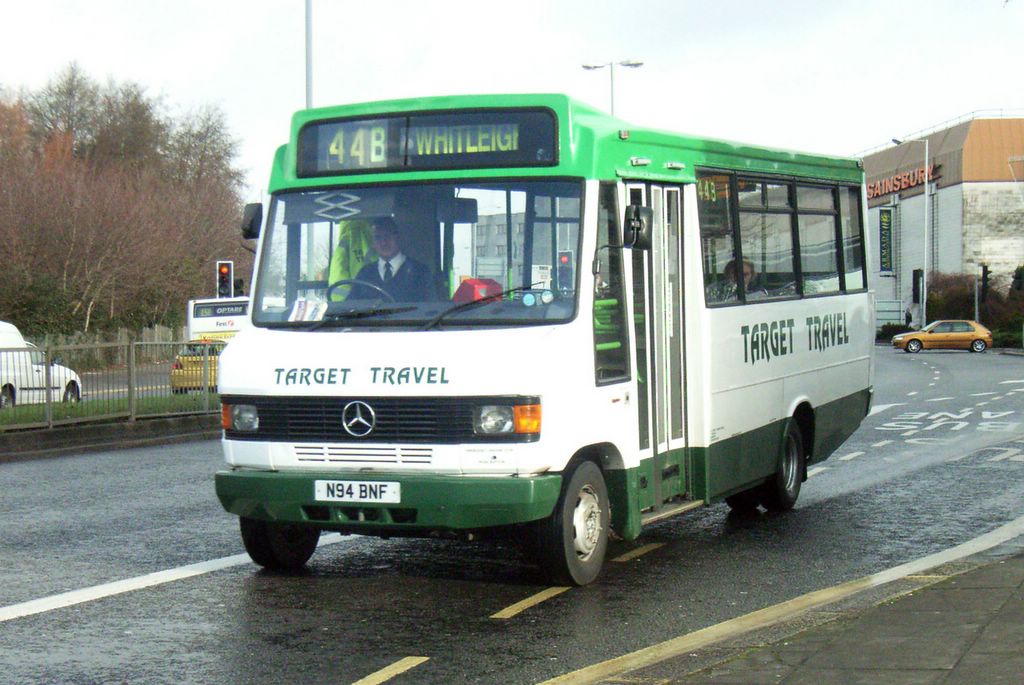
Photo taken a few days ago in Plymouth City Centre is of Target Travels Mercedes 709D N94BNF. This was purchased from Blue Bus a couple of years ago and was in service in their livery for a while. Ben Morroll has a photo of it on his fotopic site in the bluebus livery here.

This brings me to another blog I discovered recently Omnibuses which has today posted "Minibuses - where next" which is well worth a read - as is the whole blog.
He also has posted the news that Transdev has just announced the purchase of Blazefield Group. This has no local value but is yet another bus operator changing hands. There has been a real flurry of activity over the last few months with Transdev emerging as a major force to be reckoned with.

A couple of other local stories on the this is Plymouth news site tonight have caught my eye:

12:00 - 06 January 2006
Bus passengers in Plymouth will be able to get timetable details on their mobile phone within months. Residents will be able to get up-to-date information on the buses by sending a simple text message.The £1.7million project, which uses radio-navigation technology, is being seen as a key tool in the city council's bid to get more people on buses.The ambitious scheme is thought to be the largest of its kind outside London.Under the system, each of the Plymouth's 1,700 bus stops has been given a unique code.By texting the code for their nearest bus stop, passengers will be able to get details about when the next bus will arrive.A website providing codes for every bus stop in the city is to be set up by the council within three to six months.Over the next two years, each bus stop will be fitted with a sign showing its unique code.(why does this take two years?)Alex Huke, the council's public transport co-ordinator, said that the new system would help passengers to plan their journeys.He said: "We don't want to tell people that their bus is late when they're cold and wet at the bus stop."We want to give them the information they need when they are having a cup of coffee or doing some shopping."More than 160 buses have been fitted with Global Positioning System (GPS) tracking equipment as part of the scheme.'Real-time' data from each bus is transferred to an information room in the Civic Centre, where officers can check the service's overall progress.The data can also be used to help buses that are running late to make up time.At three city junctions, the system is set up so that late buses are given priority at traffic lights.Mr Huke said: "A bus running late can ask for priority if it is approaching a junction. Every bus knows where it should be and where it is."The technology is in place at Derriford roundabout, as well as junctions at Ham and Transit Way.Mr Huke said: "Those are the three we are using while we are in a testing phase. As new junctions go in, this technology will be used as a matter of course."


The other news item tonight is

12:00 - 06 January 2006
The city council is not to blame for growing traffic congestion in Plymouth, transport chiefs have insisted.But the authority admits that the city's roads will become even busier when major new developments are completed.And the council has acknowledged that changes to the road layout on Royal Parade have caused delays - but made the area safer for pedestrians.(How can the pedestrian crossing be safer than the underpass which existed before?)The news comes in the wake of a critical Government report, which claimed that the council had caused traffic congestion in Plymouth.As revealed in the Evening Herald on Tuesday, the Government criticised the council's draft Local Transport Plan 2, which sets out the city's proposals for transport from 2006 to 2011.City transport manager Chris Sane has told the Evening Herald that there were 'gaps' in the draft plan, but he added that Plymouth does not have 'huge congestion problems'.And Councillor Sue Dann, the council's Cabinet member for transport and human resources, said that busy roads were a sign that the city is thriving and moving forward.The Government Office for the South West (GOSW) said that the draft plan, which was submitted last July, was 'disjointed and contradicts itself'.The council has now drawn up an action plan to ensure the final plan is completed before the Government's deadline in March.Millions of pounds of funding depend on the Government's ultimate assessment of the plan's quality and the council's ability to deliver it.Mr Sane, the council's transportation infrastructure and engineering manager, said that 'congestion hotspots' had been identified where busy traffic could pose problems.He added: "Plymouth isn't a city with huge congestion problems. If you compare Plymouth with places like Bristol, Exeter, Birmingham and Manchester, it is not a hugely congested city."What we are concerned about is that we do have a growth and regeneration agenda, not just in the city centre but also areas like the northern corridor, including Derriford."As you create jobs and employment opportunities, that is going to increase traffic in some areas and that, therefore, has the risk that we will have congestion hotspots."Mr Sane added that major highway projects, such as the £14.5million road widening scheme at the George Junction in Derriford, showed that the council was acting now to ensure that the city does not face larger problems in the future.He said: "If we do nothing, we will start to see congestion which ultimately will then act as a brake and stifle economic activity."By doing things now, like the work at the A386 George junction, we are easing an existing bottleneck, but also creating capacity for future growth in that area."Mr Sane added: "Traffic congestion has not been caused by the council."We have got the Drake Circus development, which will bring jobs to the city and create an additional high quality shopping environment. That brings more traffic into the city."We are trying to manage the consequences of developments like that for the benefit of not only the citizens of Plymouth, but also shoppers that come in from other parts of the region."Cllr Dann said: "Having busy roads isn't bad. Having busy roads means that people want to come into the city centre to work and shop."Traffic in itself is not a bad thing. It is actually showing how the city is moving forward."Plymouth is booming and, if Plymouth is booming, it means with that we get more people, and more people travelling."Although more traffic is expected on the city's roads in the years to come, the council has no plans to introduce a congestion charge.Instead, the authority is striving to ensure that bus services in Plymouth are more reliable, providing residents with an alternative to taking their cars.But transport chiefs admit that getting people on buses will mean overturning a 'lifestyle' shift that has evolved over decades.Mr Sane said: "Where this stems from is the lifestyle that everyone chooses to live. Nowadays, we have two-adult households where both adults are working. Forty years ago, there was probably a single earner in most households."Many adults now do the school run before driving on into work. We try to encourage children to come to school by other means, whether that be bus or walking."Cllr Dann said: "We can't be accountable for when people want to travel - people make lifestyle choices."People are busy, they want to move around the city quickly, and as a council we need to be able to take all that on board and offer viable transport choices."She added: "All we can do is try to control the traffic and make sure we offer viable alternatives so people can choose how they travel."One of the 'congestion hotspots' identified in the council's draft plan is Royal Parade, where lack of space at bus stops and people using pedestrian crossings are slowing buses.Last year, an underpass which ran under Royal Parade was filled in and replaced with a pedestrian crossing as part of a £1.5million facelift of Armada Way.The work also included the creation of a 'plaza' space, which has hosted temporary attractions including an ice rink, a big wheel, and a giant screen showing matches from the Wimbledon tennis championships.Mr Sane said: "As a result of introducing the Royal Parade crossing, that has displaced some traffic onto Notte Street."For bus journey times around the inner ring, all developments have had a delaying impact. This is something that is inevitable."The crossing was put in primarily to give better pedestrian access. It was very difficult for anybody with mobility needs - such as people with pushchairs, disabled people, and elderly people - to use, compared with what we currently have."Cllr Dann added that the new crossing had turned a former 'accident hotspot' into an area where people felt safe.She said: "We don't get boy racers down Royal Parade anymore. We have accepted that the traffic has slowed down to make the road safer."Cllr Dann added that the 'plaza' had enabled the city to become one of the region's premier shopping developments.She said: "Plymouth was one of the most successful Christmas shopping centres in terms of visitor numbers in the whole of the South West. It's been really buoyant."The entertainment has made the city buzz, and that would not have happened without the Royal Parade crossing."GOSW has told the council that its draft plan 'lacks a coherent policy', with few links to the Mackay Vision for future development in the city.Mr Sane said: "We always knew there were gaps that needed substantial improvement, and we are addressing them."What we were very, very keen on was making sure we had very good public consultation. The consequence of that is that the plan went in with some gaps."Of the draft plan's relationship with the Mackay Vision, Mr Sane said: "I think they did link, but I think the issue was about how explicitly this was expressed in the draft plan."They are not in conflict - we just hadn't made it really explicit that there was a link between the two."Cllr Dann said that the council had been commended for the way it had consulted with stake-holders about the draft proposals.She said: "It shows we are trying to make our streets safer, we are trying to improve the environment in which we live, and we are trying to make the city a lot easier to get around."

Todays blog is already big enough so I wont add too many comments of my own to this yet. But I can assure you I will be coming back to it!


didbygraham