
There was an interesting article in The Guardian on Tuesday looking at the state of UK Bus services.
Councils trying to save cash are cutting local bus routes – and badly affecting access to hospital, college and a social life
A report last week by the Campaign for Better Transport (CBT) found that local authority funding for bus routes in England and Wales has been cut by 45% since 2010 and more than 3,000 routes reduced or scrapped. This prompted the Labour leader, Jeremy Corbyn, to raise the bus issue in parliament during last week’s prime minister’s questions, where he promised to “save” the bus industry and give all those aged under 26 free bus travel.
Many bus services are run commercially, mainly financed by passenger fares. Councils may then choose to subsidise those routes that are economically unviable but deemed important to maintain. Yet cash-strapped councils are being forced to reduce or scrap these subsidised bus services.
Part of the reason councils cannot afford to keep subsidising local buses is the cost of financing the free bus pass scheme. It’s mandatory to finance the concessionary travel scheme in England, which provides pensioners and disabled people with free off-peak travel on all local bus services. But the LGA estimates that there is at least a £200m shortfall for funding free bus passes, because the government does not reimburse the true cost of providing it.
David Brown, chief executive of one of the biggest bus operators, Go-Ahead Group, which runs just under 700 routes – around 10% of which are subsidised – agrees. He says cutting local buses is shortsighted. “These cuts will overwhelmingly hit jobseekers, people on low incomes and those who cannot afford a car,” he says. “Buses are the poor relation of public transport. There’s no five-year plan for buses [like there is for air, roads, rail, cycling and even walking], yet one bus can take 75 cars off the roads.”
“Politicians are fixated on their legacy. They like to open shiny new infrastructure. But rail is regressive in terms of expenditure. You can achieve much more much more quickly by investing in buses.” Brown says that where possible, Go Ahead will work with local authorities to keep subsidised routes open and weave them into one of his commercial routes. “If you are trying to go from A to B on one of councils’ subsidised routes and that route disappears, you aren’t then going to go from B to C on one of my routes.”
Not all local authorities are slashing bus routes. North East Lincolnshire, Durham, Nottingham, Cornwall and Devon have all increased their funding for buses. Richard Stevens, managing director of Plymouth Citybus, says that Cornwall, Devon and Plymouth councils all have the political will to maintain bus routes. “They recognise the importance of buses for social inclusion, economic growth and future prosperity,” he says.
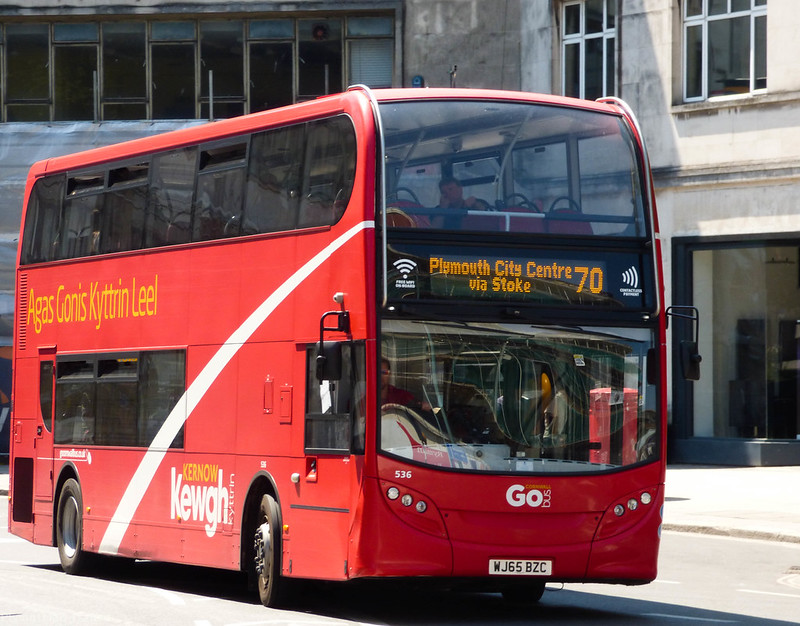
Plymouth and Cornwall bucking the trend

